The problem
Premium hardwood floor specification requires hardwood-grade differentiation, moisture-substrate verification, and edge-profile coordination — most installers cannot execute the discipline that Tier-1 boardroom hardwood demands.
Our approach
Floor Experts Ghana installs premium hardwood floors with hardwood-grade differentiation per NWFA NOFMA standards, ASTM F1869 moisture-substrate verification, and architect-coordinated edge profiling.
Floor Experts Ghana installs premium hardwood floors with hardwood-grade differentiation per NWFA NOFMA standards, ASTM F1869 moisture-substrate verification, and architect-coordinated edge profiling.
The Challenge
Premium hardwood flooring occupies a specification category where material selection, substrate condition, and installation craft must converge precisely — or the investment fails on all three counts. In Ghana’s premium office, hospitality, and residential sectors, project teams frequently encounter hardwood floors that cup, gap, or delaminate within two seasons. The root cause is almost always the same: inadequate moisture-substrate verification before installation begins, and species selection driven by aesthetics alone rather than hardwood-grade differentiation aligned to use-class and climate.
The equatorial humidity cycles of Accra’s built environment impose conditions that temperate-market hardwood specification frameworks were not designed to anticipate. A species correct for a London boardroom may perform poorly in an Airport City headquarters lobby without the substrate preparation, moisture mitigation, and acclimatisation protocols that Ghana’s climate demands. Architects, quantity surveyors, and procurement officers making hardwood specifications for Tier-1 projects deserve a flooring contractor with both the technical framework and the over-30-year local site record to close that gap.
The Floor Experts Ghana Solution
Floor Experts Ghana approaches premium hardwood specification through a methodology anchored in NWFA NOFMA hardwood-grade classification and ASTM F1869 calcium chloride moisture emission testing — applied at every project, without exception. Before a single plank is laid, the substrate undergoes documentation-grade moisture verification. Readings are recorded, reviewed against the specified hardwood species’ acceptable moisture range, and — where necessary — subfloor preparation is scoped and executed to bring the substrate within tolerance. This is not a courtesy step. It is the foundation of a warranted installation.
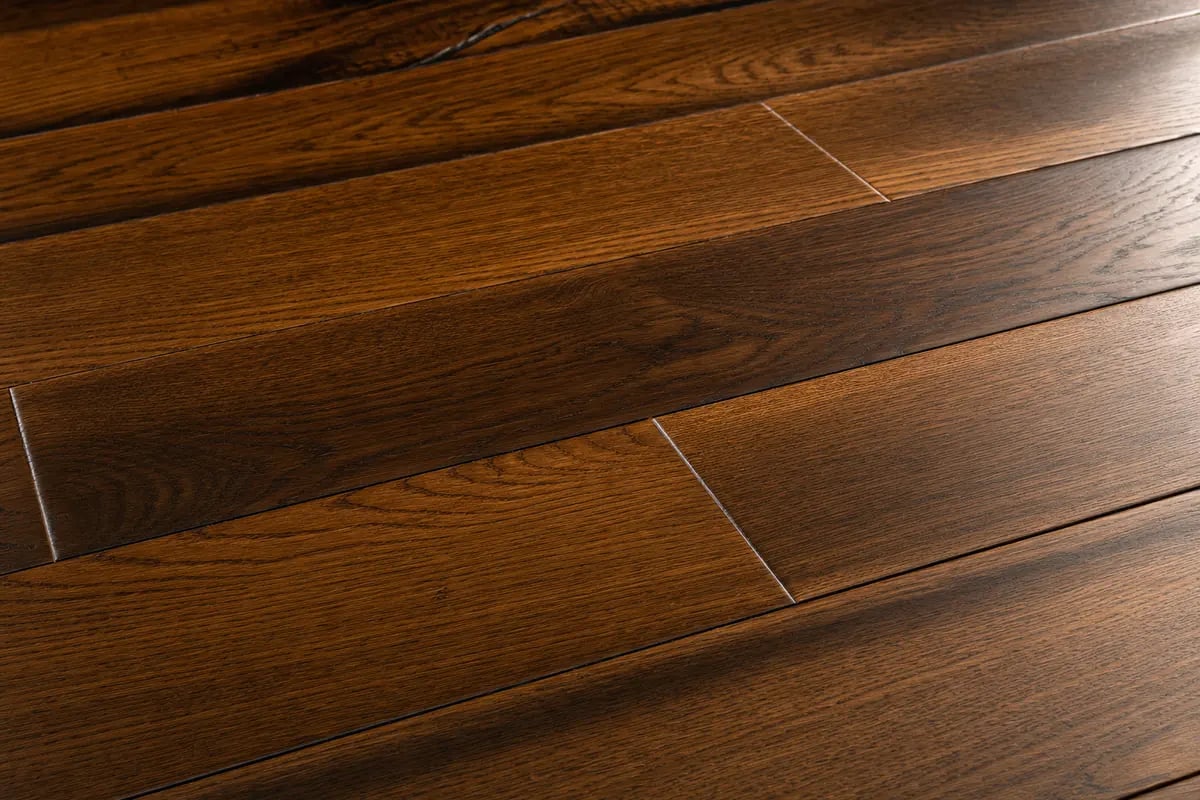
Hardwood species and grade selection is coordinated directly with project architects and interior designers. Floor Experts Ghana carries specification-grade engineered hardwood across multiple construction categories — from solid-strip domestic-grade to multi-ply engineered planks suited for raised-access office floors and acoustic-sensitive boutique hotel suites. Edge profiling, board width selection, and installation pattern (straight-lay, herringbone, brick-offset) are aligned to the architectural intent before works commence. The result is a floor system that holds dimensional stability, reflects the design intent, and is covered by manufacturer-backed installation warranty.
Material + System Specification
- Species and grade selection per NWFA NOFMA classification, matched to use-class, traffic loading, and climate exposure of each project environment
- ASTM F1869 moisture emission testing conducted pre-installation; substrate relative humidity mapped and documented for every project record
- Acoustic underlay systems specified for multi-storey office, boutique hotel, and premium residential environments where impact noise transmission is a design parameter
- Architect-coordinated edge profiling and threshold transitions specified to drawing — no site-improvised junctions at doorways, stairwells, or level changes
- Manufacturer-warranted engineered hardwood planks — multi-ply construction for dimensional stability under Ghana’s humidity cycling conditions
- Post-installation site protection protocols — hardwood surfaces boarded and taped before follow-on trades re-enter, preserving finish integrity through project completion
Typical Project Profile
A representative engagement runs across 300 to 1,800 square metres of premium hardwood installation — spanning a Tier-1 bank boardroom and executive floor suite, a boutique hotel guest corridor and lounge, or a premium residential villa principal living areas and master suite. Site works typically proceed over 10 to 25 working days depending on scope, with subfloor preparation, acclimatisation of materials, installation, finishing, and snagging carried out under a single coordinated programme. Floor Experts Ghana engages directly with the project architect and site manager throughout, providing material documentation, moisture test records, and installation compliance sheets on completion.
Outcomes
- Dimensionally stable hardwood floors verified against ASTM F1869 moisture thresholds before installation — documented and recorded
- Species and grade matched to use-class, ensuring the floor performs as specified through Ghana’s humidity cycles without cupping or gapping
- Acoustic underlay integration reducing impact noise transmission in multi-storey and hospitality environments
- Architect-aligned edge profiling and threshold detailing delivered to drawing, with no improvised site departures
- Manufacturer-backed installation warranty issued on project completion — providing clients and project owners with a documented performance guarantee