Epoxy Floor Installation
Industrial and commercial epoxy resin floor systems for warehouses, factories, food-production halls and workshops across Greater Accra — moisture-tested substrate preparation, mechanical diamond grinding, primer/build/topcoat build-ups to the correct film thickness, coving and chemical/abrasion resistance. Floor Experts Ghana — over 30 years of flooring expertise.
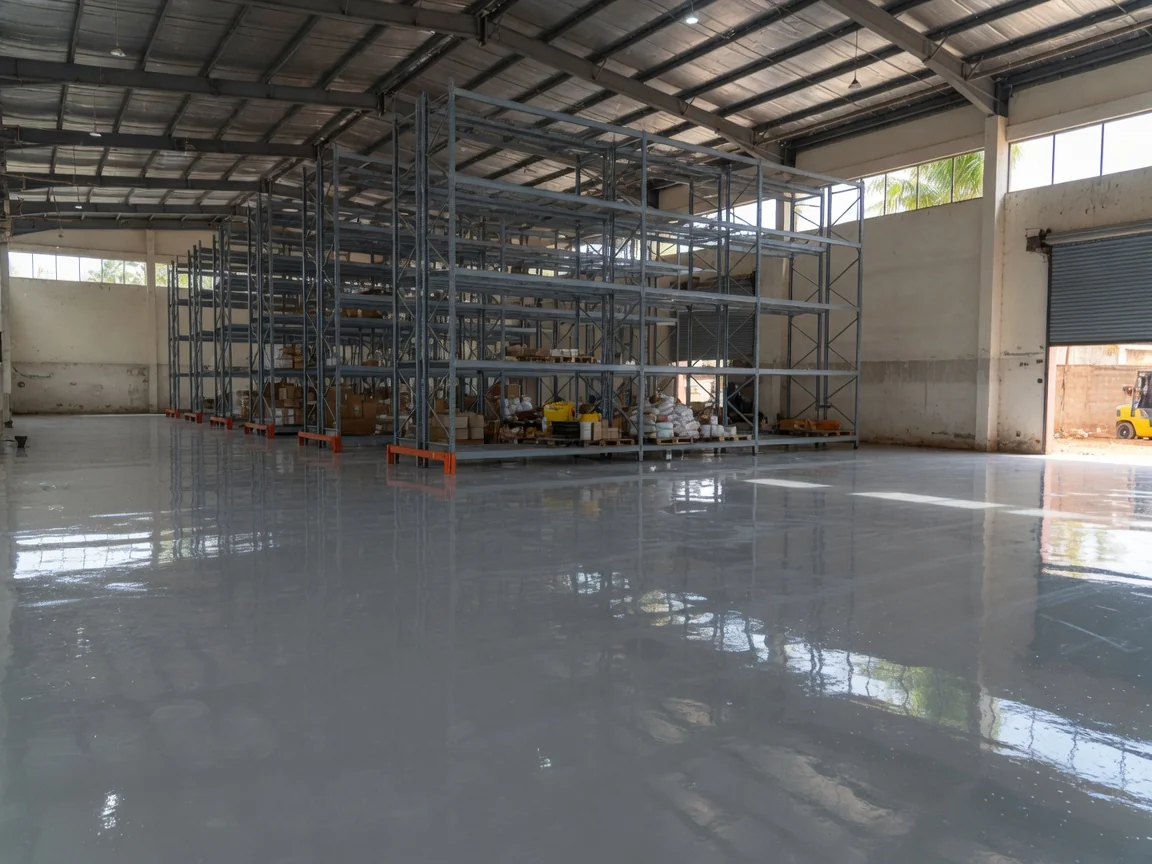
Epoxy floor installation is the application of a resin flooring system — bonded to a prepared concrete slab and built up in primer, body and topcoat layers — to give a seamless, hard-wearing, chemical-resistant and easily-cleaned surface for warehouses, factories, food-production halls, workshops and commercial back-of-house across Greater Accra. An epoxy floor is only ever as good as the slab beneath it and the preparation given to it, which is where most failed resin floors in Ghana went wrong. Floor Experts Ghana has installed industrial and commercial floor systems across Ghana for over 30 years.
Why Epoxy Floors Fail in Ghana’s Conditions — and How We Prevent It
Epoxy rarely fails because the resin is wrong; it fails because of moisture and preparation. Epoxy is a closed, impermeable film. Lay it over a ground-bearing slab with rising damp or a failed damp-proof membrane and water vapour has nowhere to go — it builds osmotic pressure under the coating and lifts it as blisters and delamination. In Ghana’s high ambient humidity and on many older slabs cast without an effective DPM, this is the single most common cause of a resin floor letting go.
The second cause is preparation. A slab that is merely acid-etched, degreased or painted over its weak surface laitance gives the resin nothing to key into, and the coating peels the first time a pallet truck turns on it. We treat these as engineering controls: every floor is moisture-tested and mechanically prepared by diamond grinding or shot-blasting to an open, sound concrete surface profile before a drop of resin is mixed. That discipline — not the brand of resin — is what makes an epoxy floor last in this climate.
Epoxy Floor Systems We Install in Accra
Roller-Applied Epoxy Coatings
A thin, seamless protective film for light-to-medium duty — storerooms, plant rooms, retail back-of-house and dust-proofing a concrete slab — sealing the surface for easy cleaning.
Self-Levelling Epoxy Screeds
A flowing 2–3 mm self-smoothing resin that levels to a flat, glossy, monolithic surface for general industrial and commercial floors, hiding minor substrate imperfection.
Broadcast Quartz & Anti-Slip Systems
Coloured quartz or aggregate broadcast into the resin to build thickness and a controlled slip-resistant texture for wet, greasy or wash-down areas — kitchens, production and loading zones.
Heavy-Duty & Food-Grade Screeds
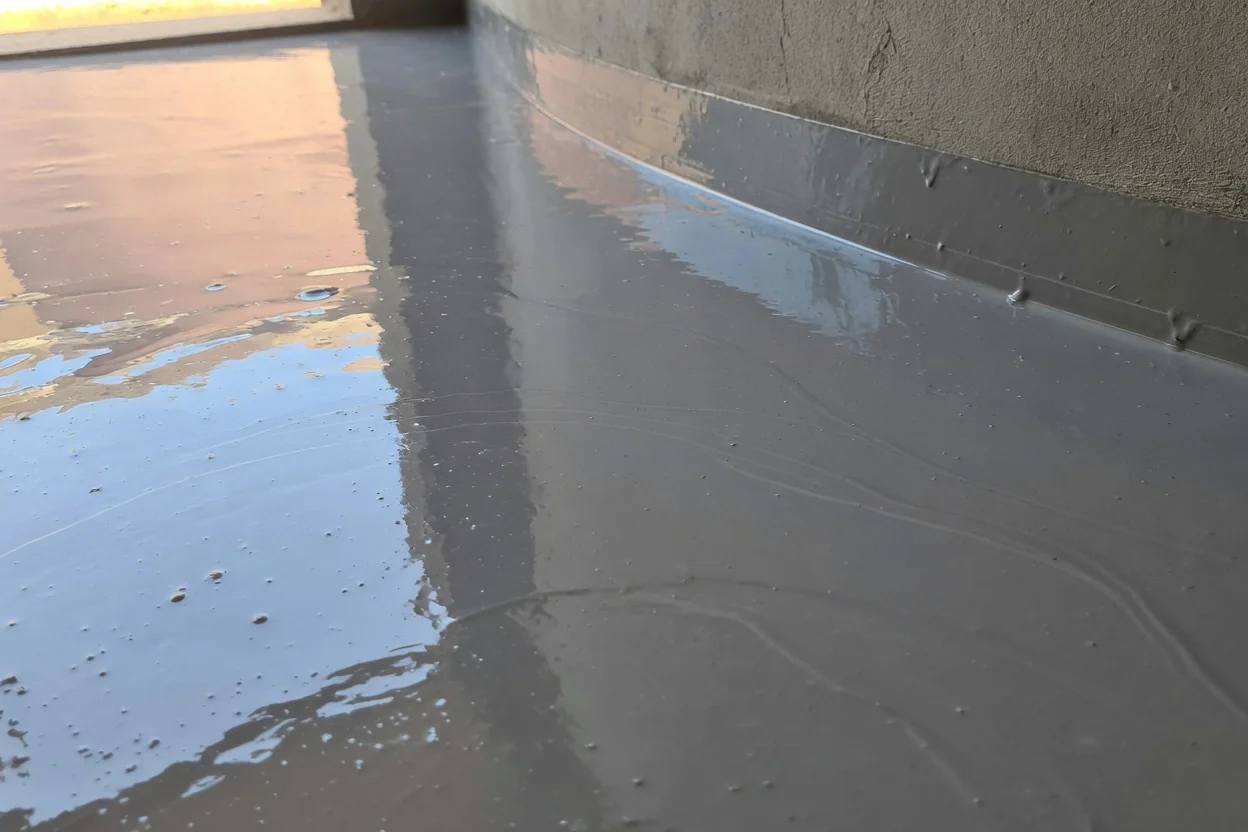
High-build epoxy or polyurethane (PU) screeds for forklift traffic, thermal shock and hot wash-down in food and beverage production, with coving formed for hygienic cleaning.
The Epoxy Flooring Standards We Work To
| Standard / control | What it governs | Why it decides the floor |
|---|---|---|
| Substrate moisture testing (RH / MVER) | Slab dryness before coating | Stops rising damp blistering and debonding the sealed resin film — the No.1 epoxy failure in Ghana |
| Mechanical preparation to CSP | Diamond grinding / shot-blasting | Removes laitance and opens the pores so the resin keys mechanically — no acid-etch shortcuts |
| Correct dry film thickness | System build-up to duty | Matches coating, self-levelling screed or heavy-duty screed to the real traffic and chemical load |
| Primer + crack/joint treatment | Bond & movement | Penetrating primer for adhesion; joints and cracks treated so they do not telegraph through |
| Coving & anti-slip profile | Hygiene & safety | Coved junctions for wash-down cleaning; controlled slip resistance in wet and greasy zones |
How We Install an Epoxy Floor
- Substrate survey & moisture testing — soundness, contamination and moisture assessed before anything is specified.
- Mechanical preparation — diamond grinding or shot-blasting to an open, sound concrete surface profile.
- Priming, crack & joint treatment — penetrating primer, resin-fill of cracks, joint reinforcement.
- Build coats & topcoat — system laid to the specified thickness, coving formed, chemical/abrasion-resistant topcoat applied and cured before traffic returns.
Choosing the Right Resin System
| System | Typical thickness | Best for |
|---|---|---|
| Roller coating | 0.3–0.8 mm | Light duty, dust-proofing, storerooms, plant rooms |
| Self-levelling epoxy | 2–3 mm | General industrial & commercial, showrooms, warehousing |
| Broadcast quartz | 3–6 mm | Wet/greasy areas, anti-slip, kitchens, production |
| Heavy-duty PU screed | 4–9 mm | Forklift traffic, thermal shock, food & beverage wash-down |
What Affects the Cost
- The system build-up specified — a thin coating costs a fraction of a heavy-duty screed
- The condition and moisture state of the existing slab, and any repairs, grinding or DPM measures required
- Coving, anti-slip texture, line-marking and colour
- Area (m²), access, and whether the space must stay partly operational during works
Every quote follows a site survey and slab moisture test — no fixed rate is given before the floor is assessed.
Applications Across Ghana
- Warehousing and logistics floors in Tema, Spintex and the Accra industrial belt
- Factory and production floors, including food and beverage wash-down areas
- Workshops, plant rooms and automotive service bays
- Retail and commercial back-of-house, cold-store approaches and pharmaceutical areas
Areas We Serve
Floor Experts Ghana installs epoxy floors across Tema, Spintex, Accra, Kumasi and the wider industrial belt — surveyed, prepared and guaranteed by a trusted Ghanaian contractor with over 30 years of flooring expertise.
Related Services
- Epoxy Self-Levelling Screeds — flowing self-smoothing resin for a flat monolithic finish
- ESD / Anti-Static Floors — conductive epoxy for electronics and sensitive environments
- Concrete Floor Installation — power-floated and polished concrete slabs
- Floor Maintenance & Repair — recoating, patching and joint repair of resin floors
Frequently Asked Questions
Why do epoxy floors peel, bubble or delaminate in Ghana? Almost always moisture and preparation. Epoxy is a sealed film, so rising damp or a failed damp-proof membrane blisters and debonds it, and a slab that is acid-etched or painted over its laitance rather than mechanically ground never keys and peels. We moisture-test and diamond-grind first.
How thick should an industrial epoxy floor be? It depends on the duty — a thin roller coating for light use, a 2–3 mm self-levelling screed for general industry, or a 4–9 mm heavy-duty PU screed for forklifts, thermal shock and food wash-down. We specify to the real load on survey.
How long before we can use the floor? Typically light foot traffic after about 24 hours and full mechanical and chemical service after around 7 days, confirmed against the specified system and temperature.
How much does an epoxy floor cost? It is quoted on survey — driven by the system build-up, slab condition and moisture, repairs, coving, grinding, area and access.